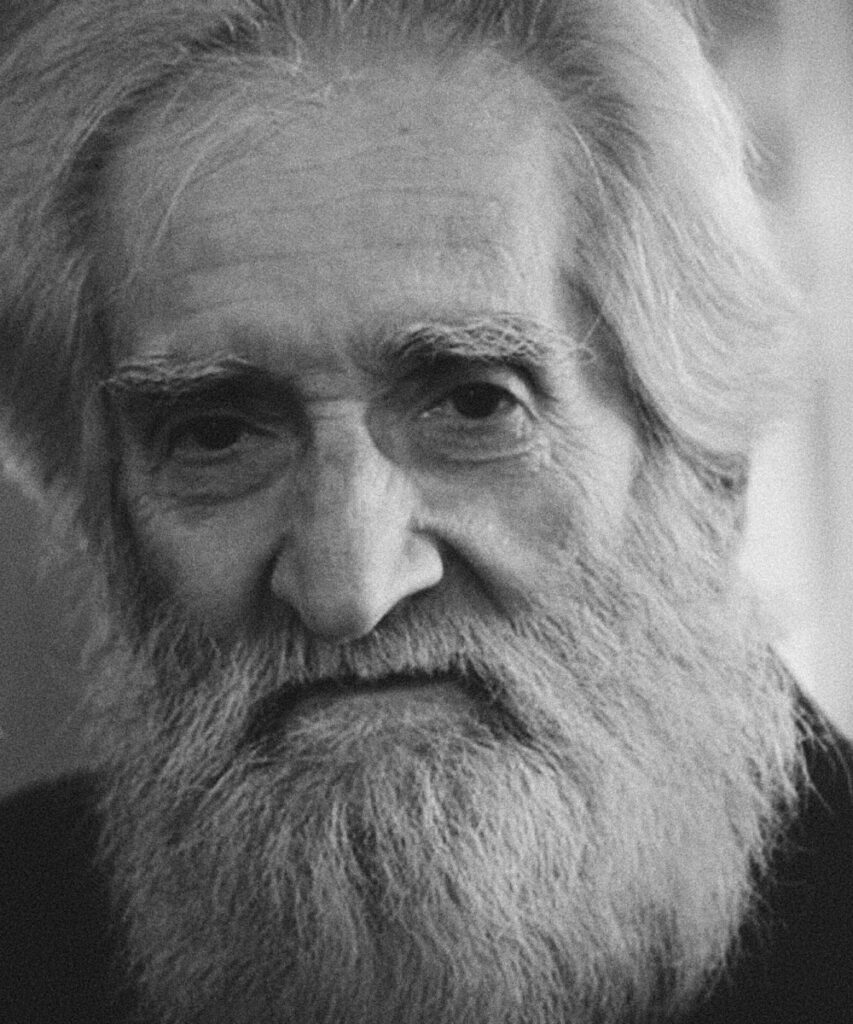
Milan Laluha
(1930 – 2013)
He was born on 11 November 1930 in Tekovské Lužany. He was a prominent painter and graphic artist. He created works in Prievidza at the age of 25–26. From 1950 to 1955 he studied at the Academy of Fine Arts and Design in Bratislava (under Prof. Fulla, Prof. Zmeták, Prof. Hoffstädter and Prof. Milly). In 1957 he was a founding member of the Mikuláš Galanda Group, whose activities came to an end in 1968. He participated in all of the group’s collective exhibitions. In 1972 he was expelled from the Slovak Union of Fine Artists, which effectively meant a “silent” ban on public exhibitions, reproduction and the purchase of his works by public galleries. This ban, however, was never strictly enforced. From 1955 he lived in Dolná Mičiná, in 1958 he settled in Martin, and from 1963 he lived and worked in Bratislava, where he died on 10 November 2013.
M. Laluha drew inspiration from the work of the father of modern art — Paul Cézanne, from whom his entire generation took its lead — and later from Cubism and the work of Fernand Léger. His teacher — painter and graphic artist Ernest Zmeták — also played a role at the beginning of Laluha’s creative journey. Drawing and the theme of the village and the human figure were always central to his work. His early works were realistic still lifes inspired by everyday objects, people close to him, and nature. A shared interest in the theme of home was felt by several artists, which they confirmed by coming together to form the Mikuláš Galanda Group. Together with painters Andrej Barčík, Rudolf Krivoš, Milan Paštéka, graphic artist Ivan Štubňa, and sculptors Vladimír Kompánek, Anton Čutek and Pavol Tóth, it was founded in 1957. From 1962, Andrej Rudavský also worked within the group. They identified with the work of Miloš Alexander Bazovský and his reflection on “having roots” in archaic objecthood and the psychology of modern reality.
They succeeded in penetrating to the essence of national identity while simultaneously uncovering the archetypal and symbolic layers of artistic creation, thus connecting Slovak visual expression with the most advanced values of contemporary European art. Laluha, as a true member of the Galanda group, renounces detail and spatial perspective. In his painterly expression he develops the vocabulary of geometric elements, and through the chromatic chord of red and blue tones he dynamises form — as in Composition with a Red Background (1958). He also applies the analysis and subsequent synthesis of form in his still lifes.
In his Martin studio (1958–1963) he focused on portraits of close friends — painters and actors. Here he developed a gallery of nudes and still lifes in a characteristic broad, planar contour and a distinctive palette — the triad of red, yellow and blue. Laluha found his most apt expression in the simultaneous contrast of primary colours — red, green, blue and yellow — and in the contrast of white and black.
He depicts the human figure, and landscape is an equally close motif. A large form — for example, a tree crown growing out of a figure — evokes a Gothic arch that extends beyond the picture plane as a continuation into our world. “On the one hand he creates independent worlds of images through which he monumentalises and lyrically transforms our world; on the other, he insists on the dynamic of the painting growing into the real world.”
In the 1970s, a marked striving for minimisation and purity of form is evident in his work — in oils, pastels and pencil drawings alike. Among other things, he creates a distinctive world of trees, venturing to the very edge of surrealistic visions (e.g. the drawing So He Rose Swiftly…, 1978).
In his pastels he employs the simplest means of form and colour to achieve expressive impact. The intensity of colour tone is elemental, charged with energy — it vibrates, radiates, transmits signals of the most intimate feelings — By the Still Life (1982), Autumn (1984).
The extensive painting and drawing oeuvre of M. Laluha forged a natural bond with the theme of the Slovak village, which he enriched through his own poetics with new layers of meaning and expression. Through variations, he seeks the essence of existence in primordial humanity.
He died in Bratislava on 10 November 2013.
In Prievidza, Milan Laluha created works that can be found on Björnsona, J. Kráľa and Malá streets.
Together with Miroslav Marček he created the decoration on Štefánikova Street and on J. C. Hronský Square.